

The Nasdaq just posted its worst week since June as AI stocks sold off and oil climbed above $100.
Stocks fell Friday and closed a mostly losing week as traders rotated out of tech and AI-related names while oil prices rose. The S&P 500 lost 1.09% to finish at 7,659.44. The Nasdaq Composite dropped 2.14% to 26,140.03. Both indexes closed below their 50-day moving averages. The Dow Jones Industrial Average fell 175.28 points, or 0.34%, to 52,002.41. The Cboe Volatility Index moved above 22 for the first time in four months. Chipmakers led the decline. The VanEck Semiconductor ETF lost 3% on the day and 10% for the week, its biggest weekly drop since April 2025, with Micron, Advanced Micro Devices, and Sandisk lower amid jitters about competition from China. The S&P 500 fell about 2% on the week. The Nasdaq shed more than 4% for its worst week since June. The Dow advanced 0.7%.
Investors have also grown concerned that tech companies are borrowing too much for the AI buildout. Shares of neoclouds such as CoreWeave, whose total debt has risen to more than $51 billion, fell nearly 12% Friday and were down 25% for the week. Michael Rosen, chief investment officer at Angeles, said the question is whether this is a systemic issue. Increased debt issuance is worth watching if it becomes excessive, he said, but “we’re not remotely close to that right now.” Energy stocks limited the Dow’s losses. West Texas Intermediate crude rose 3.51% to settle at $101.41 a barrel. Brent advanced 3.72% to $109.86 amid rising tensions between the U.S. and Iran as well as between Russia and Ukraine.
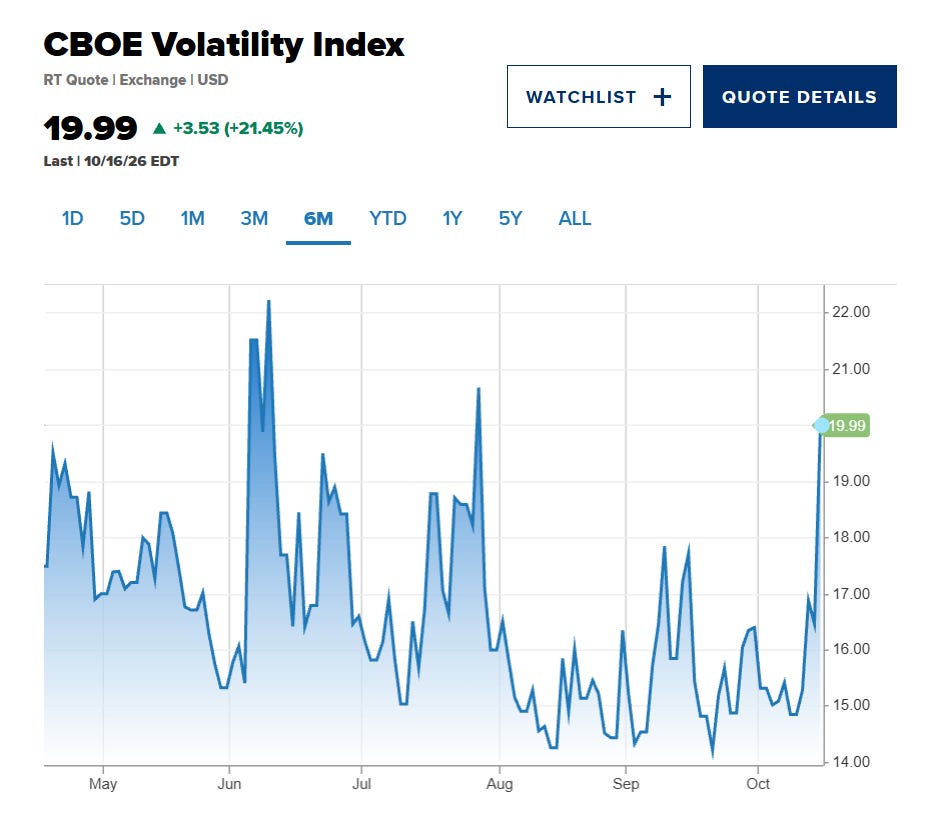
Stocks have been experiencing increased volatility as traders wonder whether Tech stocks are overvalued (Chart source: CNBC)
Investors are also grappling with hotter-than-expected inflation data, worsened by elevated energy prices in the wake of the U.S.-Iran war. Wholesale inflation this week posted its biggest gain since 2022, and consumer inflation remains well above the Fed’s 2% target. Fed Chairman Kevin Warsh spoke at an IMF event in Bangkok overnight and did not comment on whether the Fed would raise rates before year-end. Traders took that as a signal the central bank will hold policy steady later this month. The CME Group’s FedWatch tool shows an 82% chance the Fed keeps its overnight rate unchanged at its October 27-28 meeting. The so-what is that a rotation out of AI names, higher oil, and sticky inflation are weighing on the indexes at the same time, even as the market still expects the Fed to stay on hold this month.
Subscribe for free to receive our FREE Retirement Calculator and Guide
Trump waived the core tariffs in the Graham Act two days before they were due, citing national interest and fuel prices.
President Trump signed an executive order late Friday waiving parts of a recently enacted package of sanctions aimed at curbing Russia’s ability to prosecute its war against Ukraine. Titled the Lindsey O. Graham Sanctioning Russia and Iran Act of 2026, the legislation required the president to increase duties on all Russian goods imported into the U.S. by up to 500% no later than 30 days after enactment. It also required tariffs of up to 100% on countries including China and India that are among the top five purchasers of Russian crude oil or gas. Trump’s order waives these two parts and comes two days before the implementation deadline.
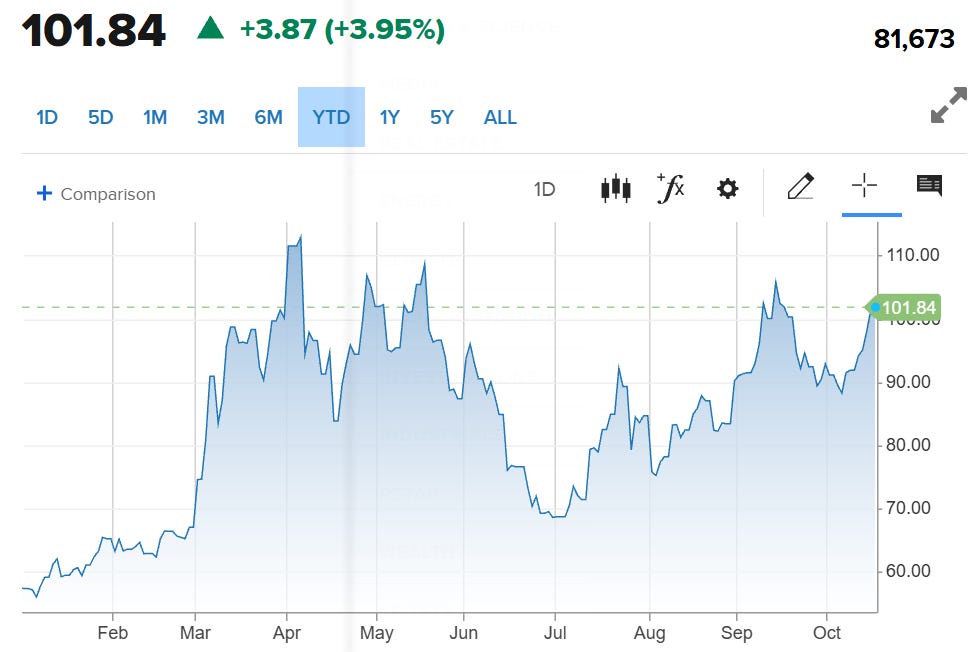
Oil prices have remained high since the beginning of the Iran War, which is becoming a political problem for Republicans going into the Midterm elections in November (Chart source: CNBC)
Russian reaction was positive. Kirill Dmitriev, Putin’s economy envoy, called the suspension an important and truly historic moment and said U.S.-Russia economic dialogue and peacemaking efforts would continue. Ukrainian President Volodymyr Zelenskyy warned in Brussels that the diesel deal could set a precedent. He also noted Ukraine’s continued reliance on U.S. military technology and intelligence. Separately, reports emerged that Ukraine restricted SpaceX’s Starlink military application, Starshield, with Elon Musk saying the U.S. government and president were ultimately responsible for any curbs.
For markets and households, energy policy is being shaped by election-year fuel prices as much as by the war itself. Waiving the new tariffs removes a lever meant to squeeze Moscow’s revenue, while the diesel waiver addresses a supply shortage.
Subscribe for free to receive our FREE Retirement Calculator and Guide
Deadly strikes on Riyadh’s airport are forcing airlines to cancel routes, lengthen flights, and treat civil aviation as a direct target
Attacks on Saudi Arabia’s second-busiest airport over the past week are showing how commercial aviation has become a greater target in Middle East conflicts. The strikes, claimed by Yemen’s Iran-backed Houthis, were the deadliest in the country in more than a decade. Over the weekend, at least 13 people were killed and more than 300 injured when a projectile hit terminals at King Khalid International Airport in Riyadh. After the FAA warned U.S. carriers about safety-of-flight risks in or over Saudi Arabia, Delta postponed the debut of their new Saudi routes until March. Mark Zee, founder of OpsGroup, called it a new paradigm: civil aviation is being directly targeted in a way it has not been for the last couple of decades.
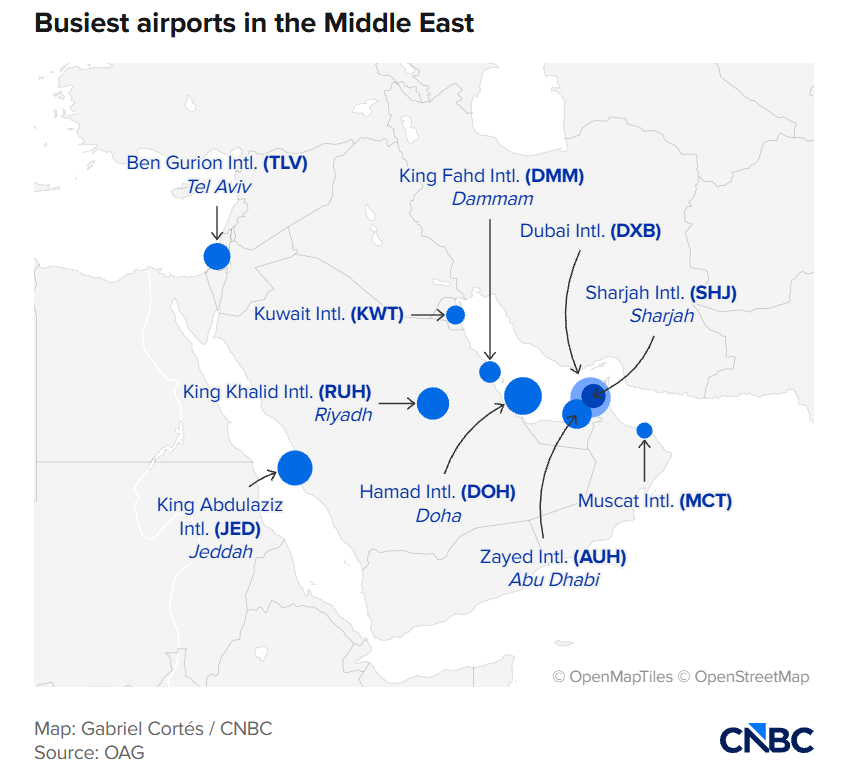
King Khalid Intl Airport in Riyadh, Saudi Arabia is one of the busiest airports in the Middle East. Recently it has come under repeated attacks, jeopardizing air traffic in the entire region
The conflicts have also cut off large parts of airspace, mainly over Iran. The outbreak of the Iran war in February set off massive aviation, travel, and safety crises, with Qantas recently changing its Perth-to-London route to avoid Iranian airspace and adding a stop in Singapore to refuel. Western commercial planes have already been flying longer routes to avoid Russian airspace for four years, since Russia’s 2022 invasion of Ukraine, which adds to airlines’ fuel bills, making these trips more expensive this year because of the same Middle East conflicts.
For the broader economy, the so-what is that a major Gulf airport is now a direct target, tourism plans are on hold, and airlines are paying more in fuel to fly around closed airspace. Saudi Arabia’s Vision 2030 push to diversify from oil and attract visitors is colliding with the operational reality that carriers can suspend or postpone service for days, weeks, or months. The cost shows up in canceled routes, longer flights, higher fuel bills, and fewer seats across the region.
Follow along on social media for key updates:
Instagram: TheMarketDispatch
Disclaimer:
The information provided by The Market Dispatch is for educational and informational purposes only and should not be construed as financial, legal, or investment advice.
The Market Dispatch, its authors, and contributors are not financial advisors, brokers, or attorneys. Any opinions, analyses, or projections expressed are solely those of the authors and do not constitute specific recommendations for any individual.
Investing involves risk, including the potential loss of principal and capital. Past performance does not guarantee future results. Before making any financial decisions or investments, you should consult with a qualified financial advisor or other professional who understands your personal circumstances.
By reading this newsletter or using any related materials, you acknowledge and agree that The Market Dispatch and its team will not be held liable for any loss, damage, or expense incurred as a result of reliance on the information provided.
This is the part of the AI boom that worries me: what happens if the investment keeps growing faster than the actual return?
The article points to tech and AI stocks selling off, semiconductor weakness, and rising concern about how much debt some companies are taking on to fund the AI buildout. At the same time, oil above $100 and stubborn inflation are putting pressure on the broader economy too.
That connects directly to The 99% Perspective’s AI, Automation, and the Future of Work: Who Gets Replaced and Who Gets Rich? and The Missing AI Infrastructure Forecast. We’ve been asking what happens when billions are poured into data centers, chips, power, and grid expansion before we fully know whether the economics will hold up.
The biggest question for me is: if the AI investment cycle turns, who absorbs the losses? The tech companies and investors—or workers, communities, utility customers, and taxpayers who helped support the buildout?
We’ve seen before how quickly a boom can become someone else’s bill.
How would we recognize when an AI investment slowdown starts becoming a household problem?
Your discussion of borrowing behind the buildout raises questions beyond stock prices. Workers, suppliers, and communities hosting data centers need to understand their exposure if financing tightens or projects stall. They may have far less flexibility to absorb disruption than investors who can sell their holdings.
At The 99% Perspective, our Florida data-center research examines infrastructure commitments, promised public benefits, and who carries the costs if expectations fall short.
A market decline alone doesn’t establish an industry crisis. Which warning signs—delayed payments, canceled projects, layoffs, or requests for public assistance—would show that financial pressure is reaching the people outside the investment markets?